KYC Verification. Raising the step that unlocks trading, inside regulation that could not be changed.
Fintech
2025
Problem
2.25%
conversion from Registration to Proof of Identity — the step that unlocks trading. Without it a user simply cannot start — every unfinished step is a lost customer.
🇪🇺 European regulated market: the number and composition of steps is set by ESMA and CySEC. Removing fields or shortening the form was not an option — everything had to be optimised inside hard constraints.
ID Proof is the target metric. This step unlocks trading. Further down the funnel there is Address proof, but that is a separate gate for withdrawals — only active traders reach it.
How I looked for causes
Ran discovery: funnel analysis in Amplitude and GA4, a UX audit, support tickets and NPS, a competitive benchmark across six brokers, and an analysis of in-product errors.
What I found and did
01Redirect into KYC + explaining the product flow
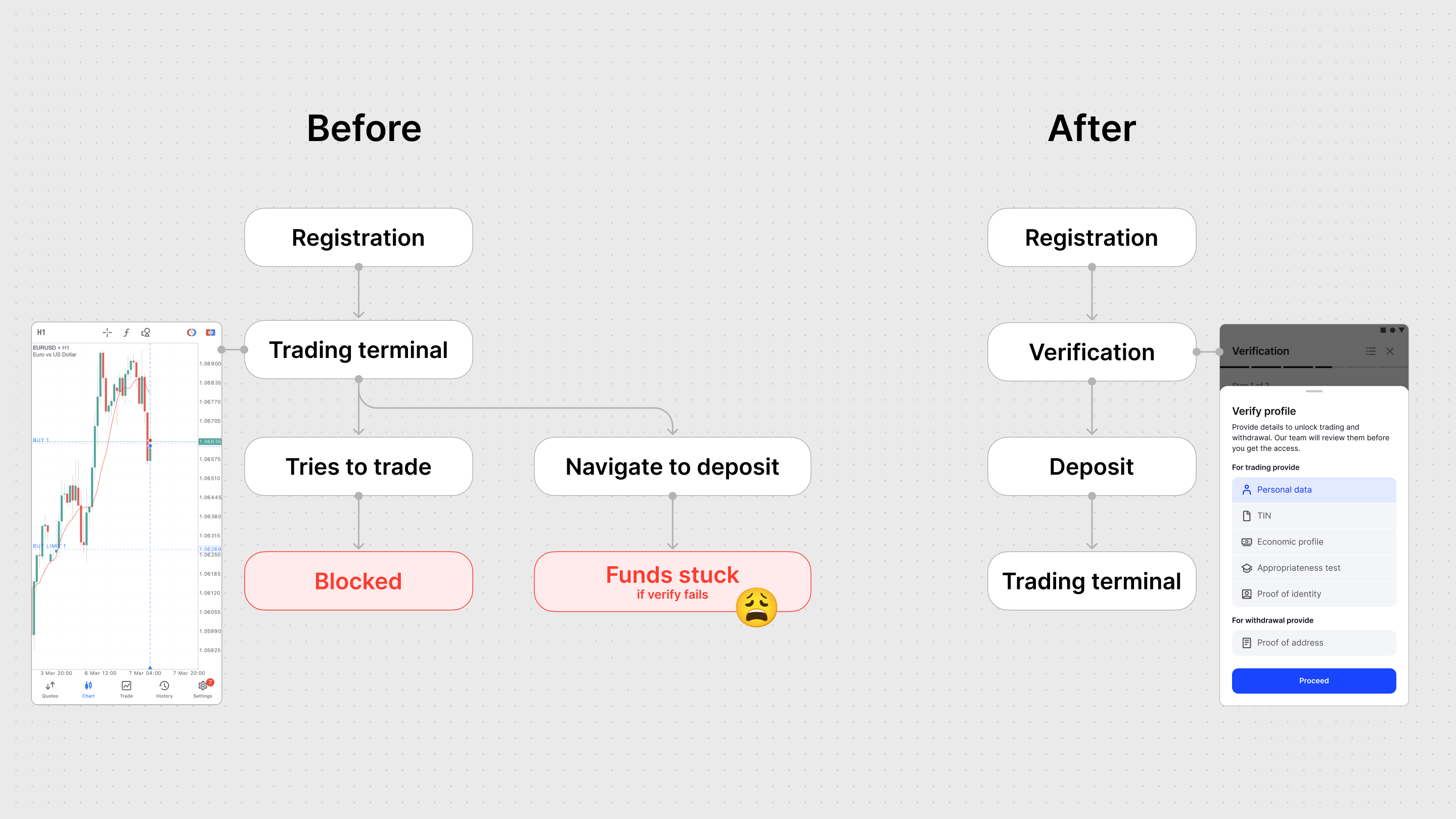
A/B testAfter registration users landed in the trading terminal but could not trade — KYC was not done. They wandered across screens, opened instruments and hit blocks. The target action was unreachable and the product never explained why.
Removed access to what did not work anyway and made the only available path obvious. On the verification screen I added a dropdown explaining the product logic: to start trading you need to pass verification. Users understood not only what to do, but why. Validated with an A/B test.
02Two-level progress: segments plus progress inside a group
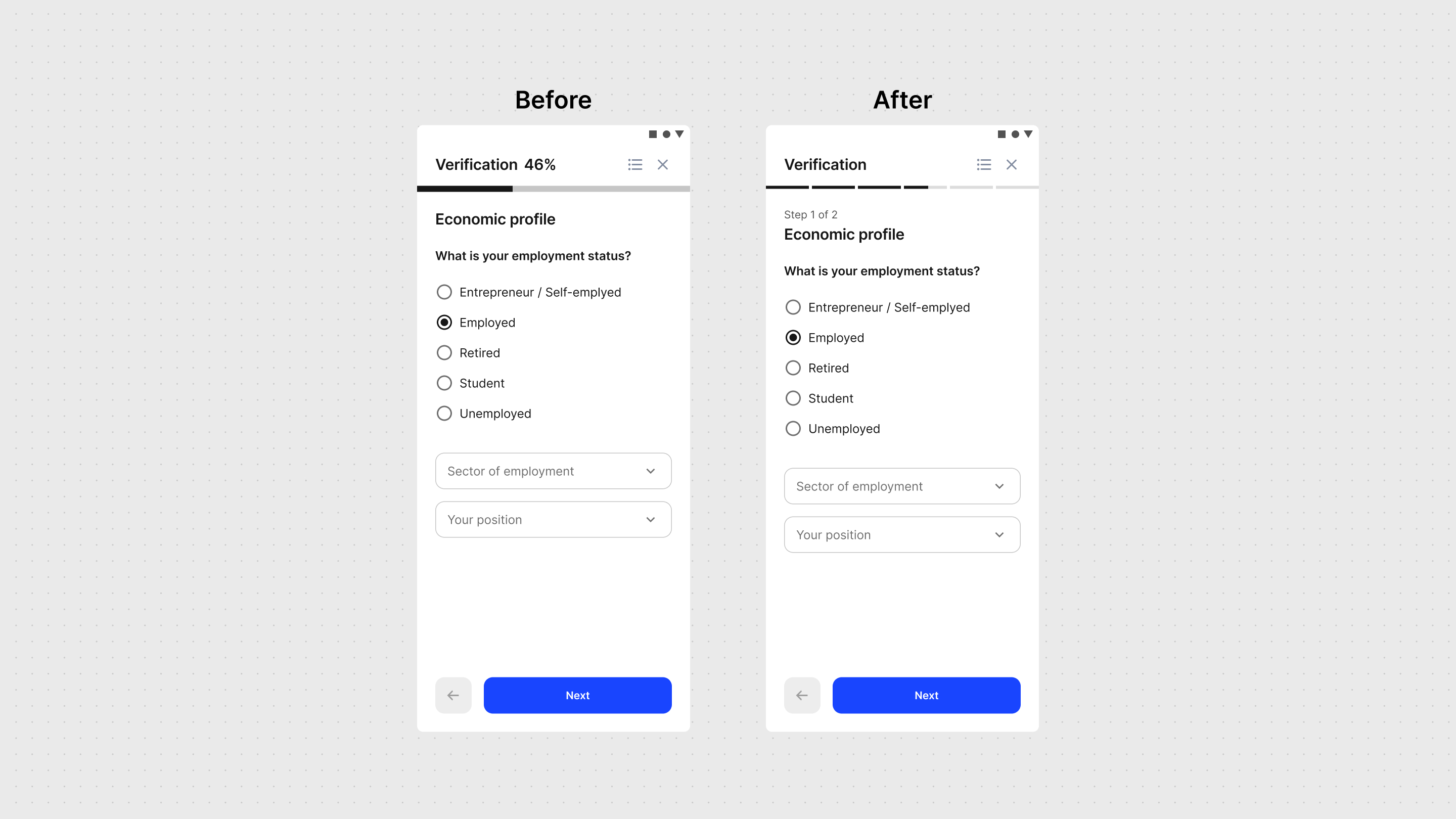
UXThe progress bar only updated after a whole question group was completed — users could not tell how much was left and felt stuck.
Six segments for six KYC groups. Inside each segment progress moves as steps get filled. Users see both where they are in the overall funnel and that they are moving right now.
03Bottom sheet before critical steps
UXThe platform competed in a crowded segment with low brand strength — users arrived without established trust, while the product requested sensitive data without explaining the value exchange.
The interface had to compensate for a weak brand. I tested it before three steps with the highest drop-off: why the data is needed, what unlocks afterwards, and security guarantees. The biggest effect was on Proof of Identity. On Personal data it created friction without obvious benefit — an open question for the next iteration.

04TIN → Codice Fiscale: localization, validation, prefill
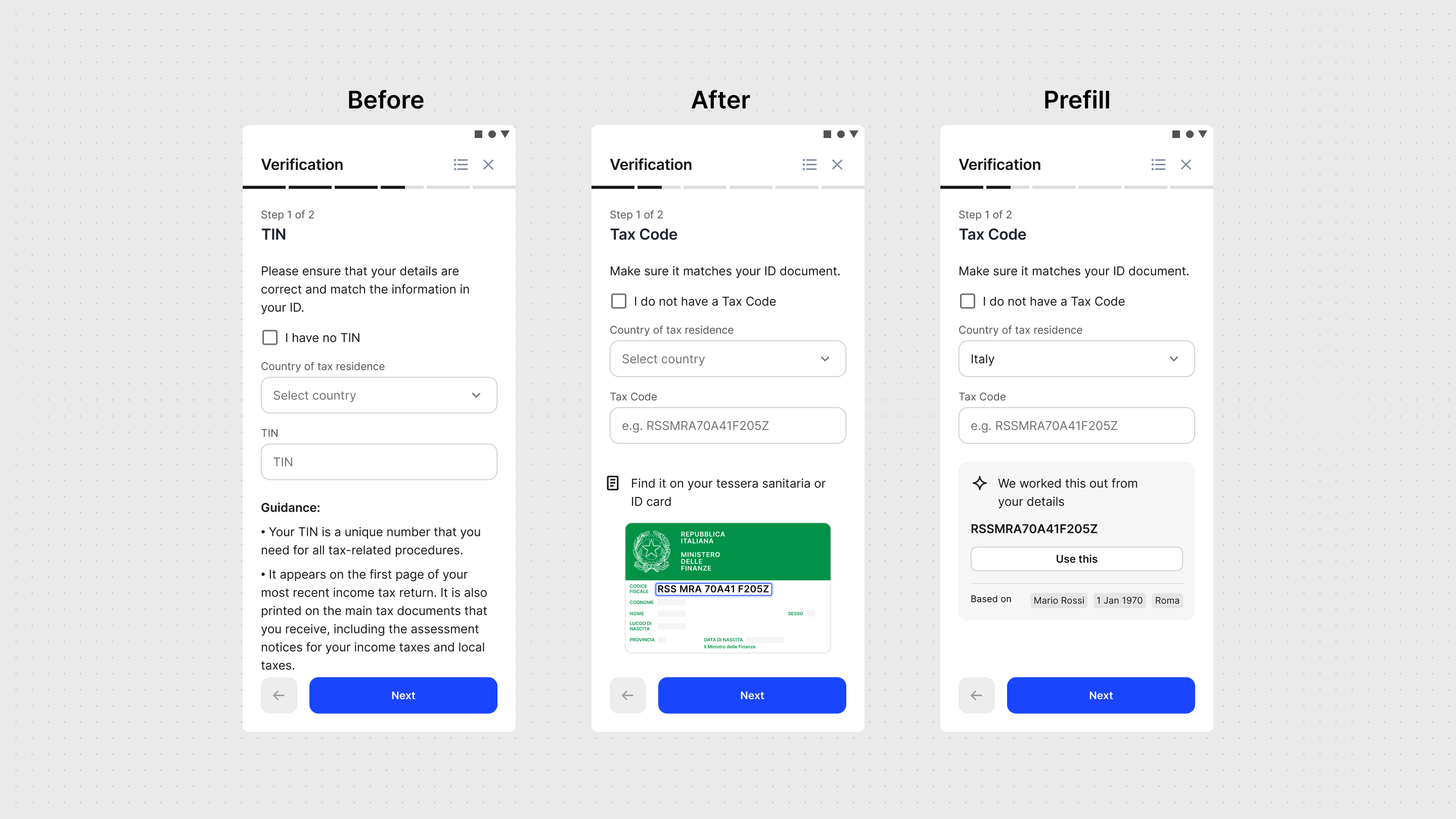
Localization75% of Italian users stated they had no TIN — they did not know their tax number is called Codice Fiscale.
Shipped: the field was localized per geo with a hint showing the actual document. The step never blocked verification — a user could write “I don’t know” and move on. The problem surfaced later: support emailed asking for a correct document, but open rate was about 30%. Most emails went unopened and accounts got blocked. Explaining the term on the step removed the cause — users understood what to enter the first time.
Designed: prefill — Codice Fiscale is computed by algorithm from data already entered: name, date and place of birth. Handed off to development.
05Postcode auto-detection from address
UXUsers did not know their postcode and left the flow to look it up — losing focus on a critical step.
Detected automatically once the address is entered — removing the reason to leave the flow.
06Sumsub integration: research and flow design
In backlogBoth document steps — Proof of Identity and Proof of Address — were reviewed manually within 4–12 hours, and not at all on weekends. An upload error was a dead end: re-uploading was impossible.
I ran a competitive analysis and made the case for the integration as a replacement for manual review on both document steps. Designed the flow: embedded SDK step, re-upload on error, and real-time review status. Handed off to development.
Result
CVR Registration → Trading unlocked
+80%
2.25% → 4.06% · ID Proof
reach to Personal info
+58%
19.6% → 31% · redirect effect
Time per step ↓
Residence −52%·ID Proof −29%·TIN −14%·Trading Knowledge −12%
The biggest gain came not from new screens, but from the entry point into the flow and the terminology — even though the set of steps itself could not be changed.